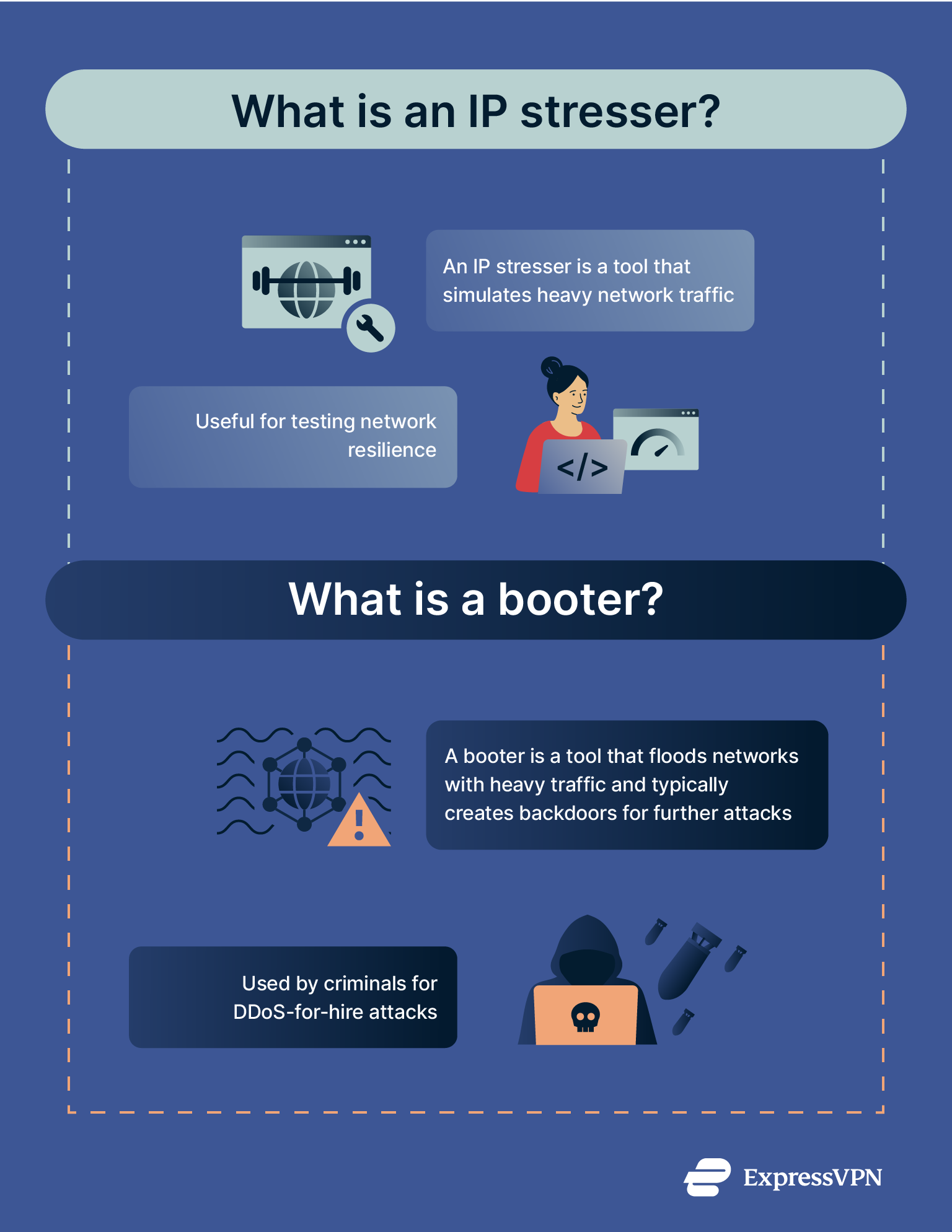
An IP stresser is a service that executes a stress test to determine the strength of a network or server by imitating a DDoS attack. When made use of for genuine functions, IP stress factors help IT teams identify just how well a system can deal with the extra lots or stress of an attack. Because IP stresser solutions in of themselves are not unlawful, cybercriminals usually disguise their DDoS booter solutions as IP stresser services supplied online.
Exactly how do DDoS booters function?
Providing illegitimate use of an IP stresser, DDoS booters are DDoS-for-hire services that can be rented on the dark web by people with little to no experience in introducing cyberattacks. Compared to the price of setting up a botnet with thousands or numerous malware-infected gadgets, leasing a DDoS booter is unbelievably cost-effective. Providers may set you back less than $25 a month, generally payable by means of PayPal, or cryptocurrencies, and some stressor websites enable a test which gives the individual access to a minimal feature of assault dimension, duration, and vectors picked. Booter sites might package their services as subscriptions that consist of tutorials and user support. Therefore, DDoS booters are popular with cybercriminals in training, called manuscript kids or skiddies, who are starting to check out just how cybercrime functions.you can find more here ip stresser from Our Articles DDoS booters are likewise utilized by skilled cyberpunks who utilize DDoS attacks as a cover or entry factor for introducing extra terrible attacks made to get to a network to take information or money.
What is a DDoS booter vs. a botnet?
Botnets are a collection of malware-infected or exploited devices that can be utilized to perform DDoS strikes or other kinds of cyberthreats. DDoS booters offer DDoS attacks as an on-demand service, using either a botnet or an assaulter’s own collection of a lot more effective servers.
What kinds of assaults do DDoS booters accomplish?
Hackers may rent booters to perform a wide variety of DDoS assaults.
- Volumetric assaults. These strikes aim to flood a target with high quantities of website traffic to consume its readily available transmission capacity, laborious sources and making the network or internet site inaccessible.
- TCP out-of-state, aka state-exhaustion, strikes. These strikes overwhelm a target’s resources by manipulating the stateful nature of TCP (Transmission Control Procedure) to wear down available connections and consume system or network resources.
- Application-layer assaults. These include Slowloris strikes and various other HTTP floods that wear down a web server or API sources. DNS pseudo-random subdomain (PRSD) attacks are a kind of application strikes, yet concentrate on the DNS method (vs. HTTP procedures, which are more traditional application assaults).
- Fragmentation strikes. These strikes send fragmented IP packages that must be rebuilded, consuming a huge quantity of the target’s sources and exhausting its capability to deal with additional requests.
- DNS reflection or boosting attacks. These strikes magnify an aggressor’s efforts by exploiting vulnerabilities in DNS servers. Attackers send demands to DNS web servers that trigger actions consisting of large quantities of info to bewilder a targeted IP address.
- IoT-based strikes. Attackers might jeopardize vulnerabilities in Internet of Things (IoT) tools to produce botnets for launching DDoS assaults that can develop huge quantities of web traffic.
Are DDoS booters unlawful?
Providing or renting DDoS booters is prohibited. Police, including the united state Department of Justice (DOJ) and worldwide police, are actively functioning to take down booter websites and apprehend individuals that provide and use them (Operation PowerOFF, for example).
What’s the very best protection versus a DDoS booter?
Organizations can resist DDoS booter solutions with the same multilayered cybersecurity steps they utilize to alleviate DDoS assaults. Best methods for DDoS protection consist of:
- Make use of a DDoS reduction service. A trusted DDoS reduction company can assist to detect and remove malicious traffic during a DDoS attack, avoiding web traffic from reaching web servers while guaranteeing legitimate users can still get to a network or web site. Cloud DDoS rubbing solutions are a method generally deployed.
- Monitor website traffic for abnormalities. Monitoring devices that identify and assess website traffic patterns can help to identify what normal website traffic resembles and spot irregular traffic that might belong to a DDoS assault.
- Deploy price restricting. Rate-limiting devices decrease the impact of a DDoS strike by restricting the number of demands from a solitary IP address or blocking website traffic from IP addresses that are recognized to be destructive.
- Increase capacity. Scaling up bandwidth, adding load-balancing capabilities, and increasing redundant systems can aid to absorb the sudden spike of web traffic during a DDoS attack.
- Make use of a material shipment network (CDN). CDNs assist disperse traffic geographically across multiple web servers and information centers, offering extra network capacity that can soak up and minimize DDoS attacks.
- Release firewalls and IPS. Firewalls and invasion avoidance systems (IPS) that are upgraded with the most recent danger knowledge can strain malicious website traffic and block suspicious IP addresses.